
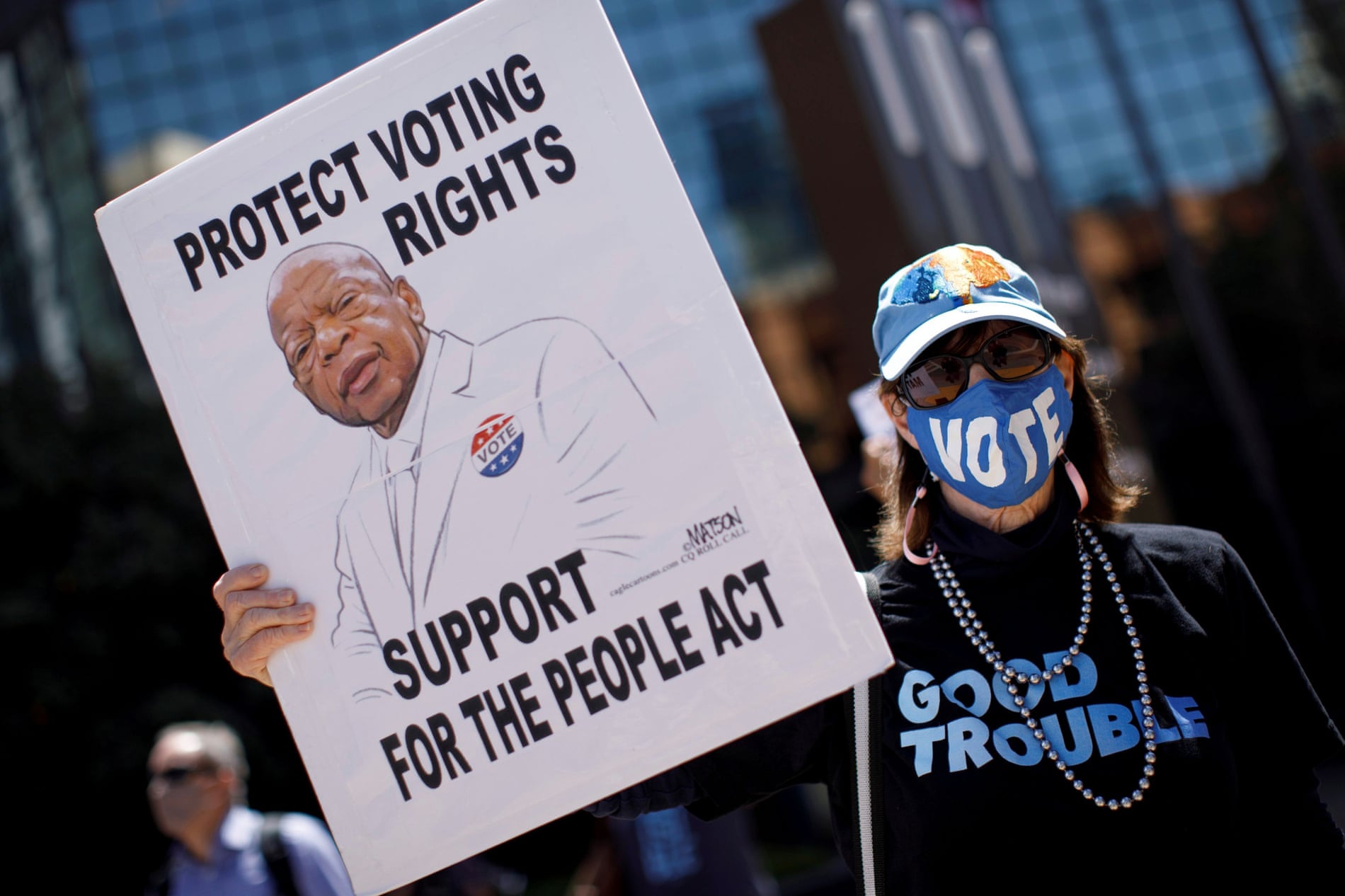
"Democrats Accuse Republicans of Voter Suppression: A Deep Dive into the Ongoing Battle Over Voting Rights"
The ongoing debate over voting rights in the United States has become a central issue in the political landscape, with Democrats frequently accusing Republicans of engaging in voter suppression tactics. This accusation stems from a series of legislative and procedural actions taken by Republican-led states, which Democrats argue are designed to restrict access to the ballot box, particularly for minority groups and low-income voters. Republicans, on the other hand, defend these actions as necessary to ensure election security and prevent voter fraud. However, Democrats see this as a thinly veiled attempt to manipulate the electorate in their favor by making it harder for certain groups to vote.
One of the most prominent flashpoints in this debate has been the introduction of strict voter identification laws. Republican lawmakers argue that requiring identification at polling stations helps to protect against voter fraud, which they claim undermines the integrity of elections. Democrats counter that voter fraud is exceedingly rare and that these laws disproportionately affect marginalized communities, including racial minorities, the elderly, and the economically disadvantaged, who are less likely to possess the required forms of ID. This, they argue, creates unnecessary barriers to voting, effectively suppressing the vote of these groups.
In addition to voter ID laws, Democrats have also criticized Republican efforts to reduce early voting periods and limit absentee or mail-in voting. States such as Georgia, Texas, and Florida have passed laws reducing the availability of these voting options, which had become increasingly popular during the COVID-19 pandemic. Democrats argue that restricting early voting and mail-in voting options disproportionately impacts voters who may not be able to take time off work or access polling stations on Election Day, again citing that this has a greater impact on minority and lower-income voters.
Gerrymandering, the practice of drawing electoral district boundaries to favor one party over another, is another key issue in the Democrats' accusations. They claim that Republicans have manipulated district boundaries in ways that dilute the voting power of certain communities, particularly communities of color. By creating districts that favor Republican candidates, Democrats argue that Republicans are effectively suppressing the votes of Democratic-leaning constituencies, ensuring that their political influence is minimized despite their population size.
Polling place closures have also sparked accusations of voter suppression. In several Republican-led states, polling places in predominantly minority and rural areas have been closed or consolidated, forcing voters to travel longer distances and wait in longer lines to cast their ballots. Democrats assert that this disproportionately affects voters who may lack access to reliable transportation, creating yet another barrier to voting. These closures are often justified by Republicans as cost-saving measures, but Democrats argue that they disproportionately target Democratic-leaning areas.
The purging of voter rolls is another tactic that Democrats claim is part of a broader effort by Republicans to suppress votes. In states like Georgia and Ohio, voters have been removed from the rolls if they have not participated in recent elections or failed to respond to verification requests. Republicans defend these purges as a way to maintain accurate voter rolls and prevent fraud, but Democrats argue that this practice disproportionately impacts minority and low-income voters, who are more likely to be affected by such purges.
Efforts to make voting by mail more difficult have been a particularly contentious issue in recent elections. During the 2020 presidential election, many states saw a dramatic increase in mail-in voting due to the pandemic. Democrats have accused Republicans of attempting to undermine this form of voting by imposing stricter requirements for mail-in ballots, such as requiring notarized signatures or eliminating the option to drop off ballots at secure locations. Democrats argue that these measures are designed to make mail-in voting less accessible, particularly for voters who may have difficulties meeting these requirements.
Republicans’ insistence on tightening voting rules is often framed as an effort to prevent voter fraud. However, studies and investigations have shown that voter fraud in the U.S. is exceedingly rare, calling into question the necessity of many of these restrictions. Democrats argue that the focus on fraud is a way for Republicans to justify restrictive voting laws that ultimately serve to limit the voting power of groups that tend to vote for Democratic candidates.
The role of the courts has also become a battleground in the fight over voting rights. In recent years, Republican-led states have passed laws that have been challenged in court by civil rights groups and Democratic lawmakers. While some courts have blocked or modified these laws, others have upheld them, leading to a patchwork of voting regulations across the country. This has created a situation where voters in some states have significantly more access to voting than those in other states, which Democrats argue undermines the principle of equal access to the ballot box.
Finally, the fight over voting rights has taken on a renewed urgency in the wake of former President Donald Trump’s baseless claims of widespread voter fraud in the 2020 election. These claims have fueled efforts by Republicans to pass more restrictive voting laws under the guise of election security. Democrats contend that these laws are part of a broader effort to delegitimize elections and sow doubt about the democratic process, which could have long-term consequences for voter confidence and participation in future elections.
In conclusion, the accusation that Republicans are trying to suppress votes is a central issue in the ongoing battle over voting rights in the U.S. Democrats believe that measures like voter ID laws, polling place closures, and restrictions on early and mail-in voting are all aimed at disenfranchising voters who are more likely to support their party. While Republicans argue that these measures are necessary for election integrity, the impact of these laws on minority and low-income voters has fueled Democratic claims of voter suppression, keeping this debate at the forefront of American politics.

0 Comments